Are you the Dog that Caught the Car?
The hospitality industry was among the first adopters of feedback, surveys, comment cards, and voice of the customer practices. It began by using Big Data to determine customer loyalty and brand protection. Today’s feedback has taken on a myriad of new meanings and uses. Post stay, post-sale, pre-sale, contact center VOC, CX, customer satisfaction, sentiment, being a few. It is the result of the realization that we, as consumers, leave behind an amazing flow of data exhaust that is used to form our buying habits. (In our specific case, we developed and have provided our online feedback management system (FMS), CustomerCount® since 2003).
Today brings BUSINESS INTELLIGENCE
It is important to note the differences between Business Intelligence and Data Analytics. The graphic below demonstrates the functions of both. The best use of data combines both, the middle section, which makes reporting of both structured and unstructured (verbatim comments) the most significant result of any serious feedback management system. https://bloomfire.com/resources/resources-what-is-business-intelligence/
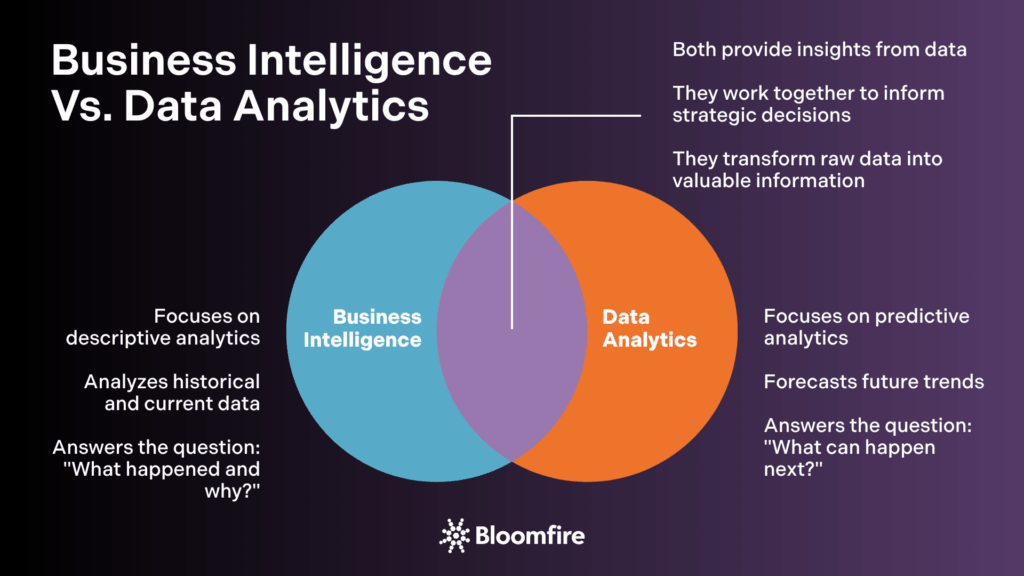
IBM defines Business intelligence (BI) as a set of technological processes for collecting, managing and analyzing organizational data to yield insights that inform business strategies and operations. https://www.ibm.com/think/topics/business-intelligence
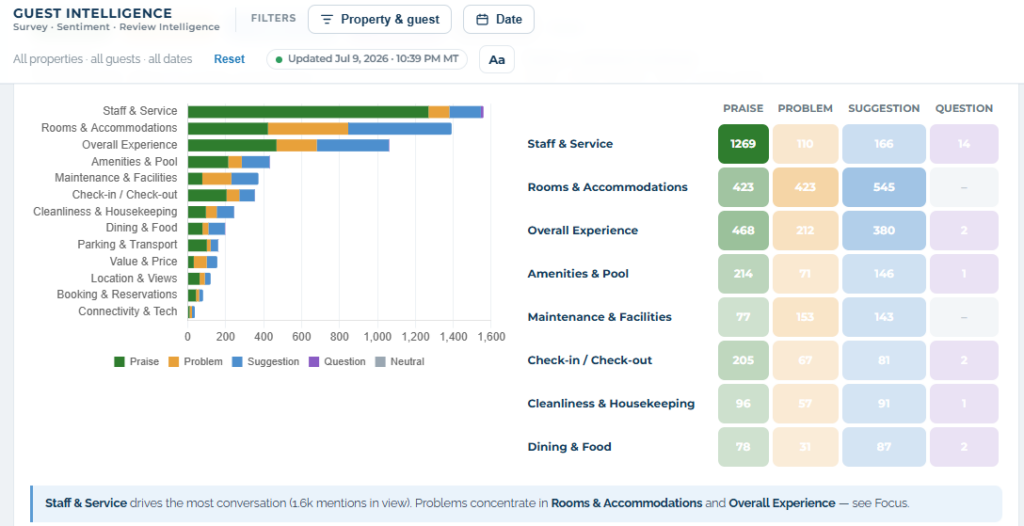
Another practical definition for our world of managing customer/employee/patient/prospect feedback; business intelligence is the use and visualization of data to understand performance, identify trends, support informed business decisions and act on the results.
If your BI is not used to analyze sentiment, identify problems, praises, suggestions and questions, all from unstructured data you are missing the point.
Where did it all start?
Remember THE call to action in the early 2000’s: BIG DATA, BIG DATA, BIG DATA
Few could define how to use Big Data to enhance a business position. You had to be a large organization to realize the true value of Big Data. IBM defined it as “Big data refers to massive, complex datasets that traditional data management systems cannot handle. When properly collected, managed and analyzed, big data can help organizations discover new insights and make better business decisions.” https://www.ibm.com/think/topics/big-data.
To further clarify, Syracuse University takes it a bit further and breaks it down into 5 main attributes: https://ischool.syracuse.edu/what-is-big-data/
- Volume: The massive scale of data
- Velocity: the speed at which new data is generated
- Variety: The different formats of data (i.e. structured, unstructured)
- Veracity: The reliability, quality and trustworthiness of the data
- Value: the useful, actionable insights that businesses can extract from the information
Now that you have all that data, what do you do with it? How do you use it to make informed business decisions?
Now there is Artificial Intelligence – the Tool that pulls it all together
I am very conflicted here being both a skeptic and advocate at the same time. So much is being discussed about the impact of AI in our everyday lives, personal and business, that it is very difficult for anyone to have a firm view. For the sake of this article, AI is the hero, not the villain.
Unless – you feed it bad information.
It’s that “Garbage in Garbage out” thing again. With incorrect big data, you can be thrown a curve ball with unknown direction and velocity. Enough to alter business decisions in bad directions. AI can be as dangerous as it can have positive impact. Given the data it is fed, it is scary accurate or it will send you on a path much like a rolling puck at a hockey game.
For example, several years ago, a parent sued a big box retailer for sending his daughter information on child rearing. Diapers, baby formula and the like. It turns out, the kid was with child and her buying habits were picked up through the code on that little card we all scan to get a discount. Notice how the coupons you get at the store seem to match your recent purchases?
In other words, with big data comes data exhaust. We all leave it everywhere. The key fob that opens the door or starts your car. All trackable and all used by someone, somewhere. So much so that an entirely new industry was created. Data Brokers is not just a term, it is a big business.
How do you sort that out.
You feed the big data into some AI gobstopper machine, and it should then spit out some report that is an interpretation of what was fed.
Feedback/survey data is a great example – feed it into AI and you will get an AI interpretation of the data, if you aren’t exact on what you are looking for the tendency is then to blame the messenger.
The conclusion about this, AI uses algorithms to determine the best answer, therefore path. To accurately gain the ability to generate intelligent business decisions using AI, start with a platform that generates intelligent, authenticated and accurate data.
ORGANIZED, AUTHENTICATED DATA COLLECTION METHOD IS THE CRITICAL FIRST STEP
The first technology adage I can remember (after the question “is it plugged in?”) was “Garbage in, Garbage out.” So true. The source of the information is the point of the spear. And the spear must hit the mark, not miss by a smidge. In an online feedback management system (FMS) Big Data is collected, fed into a system that authenticates the information then reports using all the ‘structured’ and ‘unstructured’ data collected.
Operative word being ‘reports. Reports that generates visual and actionable data that can be used to enhance guest experience, or to train salespeople, fix what is broken. It is part art, part science.
What is the point?
Manage it with precise accuracy, rely on professionals, choose your platforms wisely and be certain you are generating reporting of data to gain the best visualization of the data.
Sample Report: BI Visualization of Data