Beyond the Surface: How Modern Resort Refurbishments Elevate the Visible, Invisible, and Digital Guest Experience
When was the last time you noticed an air vent?
Was it rust-free and blowing icy air on a sweltering day? Probably not.
More likely, it was discolored, dented, housing dust bunnies or blowing hot air even with the thermostat set to chilly.
Elements like vents are designed to be incognito, blending seamlessly into surroundings so guests feel their benefit (that blessed cool air) without ever thinking about the infrastructure delivering it. The team at Hospitality Resources and Design (HRD) — Cam Abascal, Vice President of Design; Melinda Muiña, NCIDQ, Senior Designer; and Sarah Crawford, CPA, Chief Financial Officer — mentioned air vents as a refurbishment opportunity that creates meaningful impact for resorts without massive renovation budgets.
Air vents are the perfect example of something that goes completely unnoticed when operational and well-maintained but sticks out like a flashing neon sign when damaged, dirty or malfunctioning.
Not all resort refurbishments are newsworthy announcements, but that doesn’t make them any less meaningful. It may be exciting to announce a brand new, refinished pool and new lounge chairs, but if that pool is bursting with people escaping their rooms because the A/C is broken or blowing dirty air, that pool wasn’t a win. Those guests are using your amenities to flee discomfort, not enjoy your property.
That’s not to say pools aren’t important — they absolutely are. But a pool’s importance to one resort is different than its importance to another. Refurbishments work best when they’re planned and prioritized, not when you’re scrambling to fix what just broke or waiting until your decor is older than your GM.
We often look at refurbishments in categories of hard goods and soft goods, but you can also look at them in categories related to the guest experience.
- Visible Spaces (what guests see and experience)
- Invisible Operations (what guests experience but don’t notice)
- Digital Touchpoints (what guests experience before they arrive and after they depart)
Get all three right, and guests notice the experience as a whole. Miss one, and they notice the gap.
Related: Spotlight On Recreation and the Vacation Experience
Visible Spaces Worthy of Sharing
A stunning mural makes guests reach for their phones. Pose-worthy art creates social media moments. Photo-perfect spaces drive bookings.
But invest in Instagram bait while your beds sag and your vents blow rust? That’s not strategic — that’s bait and switch. Guests notice the disconnect and they will post about it, but not in the way you want.
Travelers actively seek genuine, non-marketing perspectives. TripAdvisor’s advanced filters let guests view photos submitted only by travelers, separate from management uploads. Google does the same. Your spaces need to look as good in guest photos as they do in your professional shots – because that’s where booking decisions are influenced.
When creating visible spaces worthy of sharing, only invest in the extras or additions when the basics aren’t generating monthly complaints.
Strategic Planning That Saves Money and Headaches
According to Hospitality Resources and Design’s team, the smartest refurbishments start with a plan, not a panic because upfront thinking prevents costly mistakes later.
“Buy all fabric upfront, every yard you’ll need across multiple phases,” advises Melinda Muiña, NCIDQ, Senior Designer. This keeps design consistent throughout your property and locks in volume discounts. Plus, you’re protected against discontinued patterns that could derail your vision months into the project. Hospitality Resource and Design typically recommends ordering 2-5% extra depending on project scope to account for waste and future repairs.
For projects spanning several years, Cam Abascal, Vice President of Design, explains that manufacturer relationships become crucial. “Large, multi-phase orders often come with storage deals — the manufacturer holds your fabric until you’re ready for each phase ,” she notes. This prevents properties from turning space they already don’t have into storage while protecting the investment.
One benefit of working with an established firm like Hospitality Resources and Design is these existing relationships and logistical expertise. From calculating correct order amounts to arranging storage to coordinating delivery schedules — these behind-the-scenes details can make or break a project. It’s the kind of institutional knowledge that prevents costly mistakes and delays.
The team recommends phasing installations strategically in ways that maintain adequate inventory for guests while allowing properties to learn from the first phase before proceeding. There’s no perfect template for phasing a project, it’s a puzzle to be pieced together with each individual resort.
Lighting That Looks Good In Person & On Screen
Hospitality Resources and Design’s team agrees that like air vents, lighting works best when guests don’t think about it. Poor lighting sticks out in two ways — how the room feels when someone’s inside it and how it photographs when they want to share it.
“We consult extensively on lighting because it affects every other design decision,” explains Muiña. Light that’s too dim makes spaces feel cramped and unwelcoming. Too bright creates a clinical, uncomfortable atmosphere. Yellowed or inconsistent color temperatures make even new furnishings look dated and cheap.
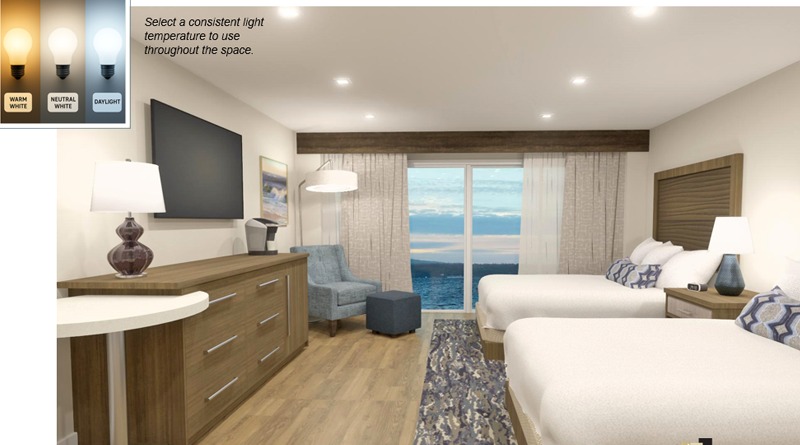
But here’s what the team says many properties miss — lighting that feels adequate in person can photograph terribly. Certain lamp shades create harsh shadows or unflattering color casts in photos. Inconsistent bulb temperatures across a room create an amateur, patchwork look in images.
Hospitality Resources and Design’s solution? Update bulbs to consistent color temperature across all fixtures as one of the simplest, highest-impact changes possible. Pair this with updated fixtures — swapping dated lampshades for clean, white linen drum shades — and the transformation breathes fresh life into spaces without major renovation.
Related: Improve your Resort with Illumination
Artwork That Tells Your Story
Generic hotel art tells guests nothing about why they should be excited to be at your specific location. It doesn’t differentiate if they are on the beaches of the Carolinas or the alpine lakes of the Rockies. Strategic artwork connects guests to your destination while creating natural photo opportunities.
Muiña’s design efforts often involve local artists and photographers. “We reach out to area talent whose work captures something iconic about your location, even if it’s a small detail that represents the local community.”
Consider the medium, not just the image. Printing on wood, incorporating local materials like shells for coastal properties, or using unique framing all add texture and authenticity that guests notice and appreciate.
The frames, visuals and materials should work together to give a genuine nod to what’s around you. This creates spaces that feel rooted in place rather than dropped in from a corporate catalog.
Functional Safety as Hidden Opportunity
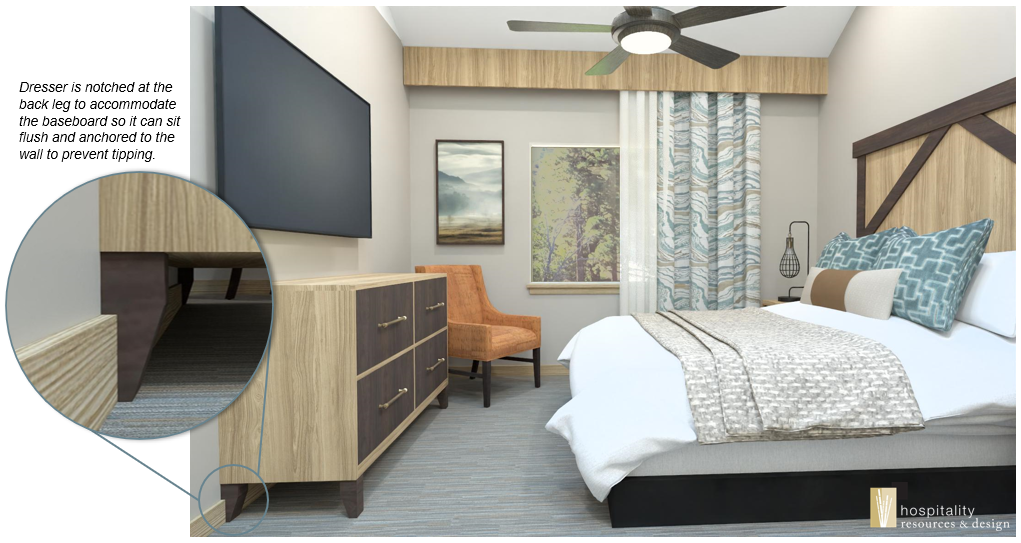
Sometimes refurbishments are required, not optional. The 2023 case goods safety standards mandated that dressers and wardrobes meet specific tip-over rates and include safety features like wall anchoring.
Rather than viewing these requirements as burdens, Abascal suggests treating them as refurbishment opportunities. Adding weights, notching pieces for wall anchors, or modifying existing furniture can be done in ways that enhance rather than compromise your design.
“Liability considerations are part of every decision, but they don’t have to limit creativity,” she notes. “Work with designers who understand how to meet safety requirements while maintaining the aesthetic you want.”
Small Details That Get Shared
Savvy travelers who post online appreciate small details that signal attention to quality. Soft-close drawers feel premium. Lighting with built-in USB ports combines function with convenience. Updated hardware on existing furniture can make pieces feel completely refreshed.
The Hospitality Resources and Design team emphasizes keeping items on replacement cycles rather than waiting for obvious wear. “Guests notice when some units have sofas that look acceptable while others clearly don’t,” explains Muiña. “Seating should be on a seven-year cycle, regardless of how individual pieces are holding up. Consistency across your property matters more than squeezing extra life from furniture that’s ‘still okay.’”
Logistics That Make or Break Projects
The best design ideas fail if you can’t actually implement them. Hospitality Resources and Design plans logistics as carefully as aesthetics, because beautiful furniture stuck in a truck doesn’t help anyone.
“You have to consider how you’re going to get the pieces in before you order them — from elevators to hallway dimensions, it all matters,” advises Abascal.
Even truck access matters. Mattresses typically arrive on 53-foot trucks. “If your property can’t accommodate large delivery vehicles, you need to arrange alternative transportation in advance,” Abascal explains. “These details seem minor until they become expensive problems.”
One day of delivery disruption can be an inconvenience to your building and guests — and when that’s someone’s vacation, every day and every experience matters. One mismanaged delivery could lead to poor online reviews. Beyond guest impact, logistical oversights make projects inefficient, extend timelines, create costly delays, and in worst cases, make installations impossible after furniture is already ordered.
While Abascal’s title as HRD’s Vice President of Design may suggest she’s an expert designer, her 26 years of experience blending that eye for design with being a licensed building contractor, and her commercial and hospitality experience, makes her an expert in value engineering. A brilliant concept that helps when perfect pieces exceed budget. The team suggests alternatives that achieve the same visual impact at lower cost,or modifies specifications to fit financial parameters without sacrificing the overall vision. It’s all about using expertise to determine what refurbishments hold the key to the best value.
Crawford points to a recent project where careful vendor negotiations and quality control saved a client $40,000 on flooring alone. “We go to bat for our clients on everything from tariff-related costs to volume pricing,” she notes. “After installation, warranty support protects your investment. Choose partners who stand behind their work, have established trusted vendor partnerships and respond quickly to issues.”
The best visible spaces work because every detail — from major furniture selections to bulb color temperature — supports the same goal: creating environments so appealing and functional that guests want to stay, return, and share their experience with others.
Invisible Operations Earning Their Anonymity
The best operational improvements are the ones guests never notice — faster check-ins, seamless communication, perfectly timed housekeeping. When operations work flawlessly, they become invisible. When they don’t, they become the entire guest experience.

AI: The Tool Guests Don’t Want to See
AI may be one of the hottest business trends, but it’s also one that guests either don’t care about or straight up have disdain for. There’s the matter of perceived value — things that feel mass produced or AI-generated can make customers feel like they aren’t getting value that warrants a high price tag.
AI doesn’t sell resorts. It gives resorts the energy, time and resources to focus on what guests actually want from resort staff — genuine hospitality, personalized and hands-on help when needed and undivided, in-person attention.
Grand Pacific Resorts, a California-based resort management and development company with over 30 years in vacation ownership, has quietly implemented AI across multiple operational touchpoints — from predictive maintenance scheduling to automated inventory management to streamlined communication workflows. Most of these applications remain completely invisible to guests, which is exactly the point. The technology handles routine tasks so staff can focus on creating memorable experiences.
In Hilton Head Island at Royal Dunes, worked with their management company, South Carolina based Resort Management & Consulting Group to automate processes using flexible automation tools like Zapier. Guests don’t see the automation but experience faster follow-up and smoother operations and staff have the structured process to focus on other efforts while confidently knowing nothing fell through the cracks.
Both independent resorts and large companies have automation opportunities. Boutique properties can use tools like Zapier with affordable, endless integrations. Larger management companies and developers may turn to enterprise solutions like Rule Engine and Workflow Automation tools like Decisions, which can deploy centrally across organizations from operations to accounting to HR and connect all systems.
Scheduled Operations as Refurbishment Strategy
Your operational processes should be scheduled, reviewed and considered part of your refurbishment schedule. Grand Pacific Resorts conducts annual photo and video audits where their in-house photographer reaches out to general managers with a template to review interior and exterior content. If refurbishments or construction warrant a refresh, they schedule that resort for production.
The threshold test is what impact it has on the guest experience.
This systematic approach demonstrates the benefit of working with structured management companies — these processes don’t have to be created from scratch. They offer tried, tested and continuously improved systems that independent resorts might struggle to develop alone.
The People Behind Seamless Experiences
Technology and systems only work when people execute them properly. Housekeeping staff, maintenance crews, and front desk associates are in guest-facing situations daily — they’re often the first to notice what’s working and what isn’t.
But seamless doesn’t mean invisible. Things go wrong, rooms need cleaning, staff must be present when guests need assistance. The key is investing in training that empowers these team members to handle situations professionally and communicate effectively with guests.
As explored in a recent Resort Trades article on hospitality innovation, the most successful properties create environments where frontline staff feel empowered to speak up about operational improvements. Housekeeping staff spend more time in guest rooms than management — they should be trained to notice details and encouraged to share insights about what guests are experiencing.
When maintenance teams are properly trained in guest interaction, a routine repair becomes an opportunity to demonstrate care and attention. When housekeeping staff can confidently address guest questions or concerns, they become ambassadors rather than background workers.
This investment in people prevents small operational issues from becoming guest complaints while creating opportunities for positive interactions that guests remember.
When invisible operations work perfectly, guests experience seamless service without seeing the systems and training that created it.
Digital Touchpoints Engaging from Click to Comeback
“Just like a lobby, your website welcomes guests and owners and needs to be refreshed,” explains Renée Wagner, Senior Director of Creative Services & Brand Management at Grand Pacific Resorts. Her team’s recent website overhaul for Hanalei Bay Resort demonstrates exactly why digital refurbishment matters as much as physical updates. (See Before and After)
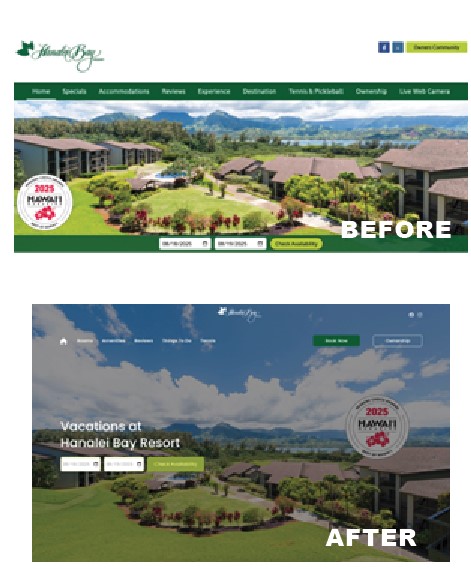
The visual transformation speaks for itself. The old site felt dated and cluttered, while the refreshed version showcases the property’s natural beauty with clean, modern design that loads quickly and functions seamlessly across devices. More importantly, Wagner notes, “We have data to back up the need for a refresh” — evidence that digital updates directly impact booking behavior and guest engagement.
The Digital Journey That Never Ends
For timeshare properties, digital touchpoints span the entire guest relationship. Pre-arrival communications help rental guests prepare for stays and assist owners with booking their weeks, banking time, or staying informed about resort developments. Some communications are legally required — annual meetings, financial reports, governance updates.
But the digital relationship extends far beyond arrival and departure. Post-checkout follow-up includes review requests, promotional offers for future stays and retargeting campaigns that keep your property top-of-mind. Social media maintains ongoing engagement, encourages user-generated content and showcases property updates to both past and potential guests.
Like the previous two refurbishment categories, digital touchpoints include both visible and invisible elements. Guests see your social media posts, website design and email newsletters. They don’t see the search engine optimization work, ad targeting strategy, email automation systems or website framework ensuring fast, functional performance across devices.
When Crisis Demands Real-Time Response
Having efficient digital systems becomes crucial during unexpected events. From natural disasters forcing evacuation orders to viral social media incidents, resorts need the capability to communicate quickly and effectively across multiple channels simultaneously.
My communications and public relations experience with resorts involves both preparation and real-time response to issues — from viral news stories to properties forced to close due to hurricane evacuation orders. These situations demand immediate, coordinated digital responses across websites, social media, email systems and sometimes traditional media outreach.
When your routine digital operations are streamlined and automated, staff has the bandwidth to focus on crisis communication that protects both guest safety and brand reputation. But if you’re still manually managing basic email campaigns or struggling with an outdated website, emergency communication becomes nearly impossible to execute well.
Content That Spans Generations
Timeshare owners represent multiple generations, requiring diverse communication approaches. Owner magazines still provide valuable touchpoints for older demographics who prefer print communications, though digital flipbook-style magazines offer an optimized digital experience for those who prefer physical-style reading without printing costs. Younger owners expect instant updates via social media and mobile-optimized emails or texts.
Resort budgets need to consider the cost of mailings and how to effectively communicate with digital tools. Looking at communications and digital refurbishment is a way to both improve experience AND save money if your printing and mailing bills are breaking the budget or your bottom line could benefit from a rental boost from expanded online efforts.
Some owners also want a voice — a way to email the board or respond to resort updates on social media. Encouraging and being present for these online conversations builds owner engagement and trust rather than letting concerns fester in private owner groups.
The most effective digital strategies acknowledge these preferences rather than forcing all communications into a single format. Some owners want detailed quarterly reports. Others prefer quick Instagram stories about property improvements or local events. Both approaches serve the same goal — keeping owners engaged and informed about their investment.
The Infrastructure Behind Seamless Digital Experiences
Like invisible operations, the best digital touchpoints work because of systems guests never see. Email templates automatically trigger based on booking dates, sending pre-arrival information, local recommendations, and post-stay follow-up sequences. Website analytics track which content drives bookings and which pages cause visitors to leave.
Social media management tools schedule content across platforms while monitoring mentions and reviews in real-time. Search engine optimization ensures your property appears when potential guests search for your destination, amenities, or specific experiences.
The happiest guests are the ones who found exactly what they were looking for. When your online presence accurately reflects your property, incoming guest expectations are accurate and their perceived value expectations aren’t disappointed. When they are disappointed, you get unhappy guests, regretful stays, and negative reviews that weren’t worth the room revenue they generated.
These backend systems create the efficiency that allows marketing teams to focus on creating compelling content, responding personally to guest inquiries, and developing campaigns that drive both new bookings and repeat visits.
Wagner’s website refresh exemplifies strategic digital refurbishment — addressing both aesthetic appeal and functional performance while creating a foundation for ongoing marketing success. The visual improvement attracts visitors, but the underlying technical improvements ensure they can easily book their stay.
When digital touchpoints work seamlessly together, they create a continuous relationship that extends far beyond a single stay — turning first-time visitors into repeat guests and satisfied owners into property ambassadors.
Beyond Surface Deep
The air vent principle applies whether you’re selecting furniture, scheduling maintenance audits, or refreshing your website. The best refurbishments — physical, operational, and digital — work because guests notice the experience, not the effort behind it.
Strategic refurbishment isn’t about chasing the latest trends or spending the most money. It’s about understanding what your guests actually need and creating systems that deliver it consistently. When a family escapes to perfectly cooled rooms, experiences seamless check-in, and books their return visit on a fast-loading website, they’re experiencing the compound effect of thoughtful planning across all three areas.
The properties that excel long-term are the ones that think beyond individual projects to create integrated experiences. They understand that Instagram-worthy spaces mean nothing without operational excellence, and that the most sophisticated backend systems fail without authentic human hospitality.
Get all three right, and refurbishment becomes more than renovation — it becomes a competitive advantage.
Hi, I’m Kelley Ellert and each month this column will be coming to you from my curious mind. I look forward to exploring ways that technology amplifies hospitality and data enriches human connection. I own a marketing company, Waterwheel Marketing, that helps businesses cultivate digital ecosystems where efforts work together, not in silos.
As a lifelong learner and curious traveler, I’m always seeking fresh perspectives on how innovation can make hospitality more remarkable. Through this column, I’ll explore practical solutions that create more time for what hospitality is all about – exceptional guest experiences.